Showing posts with label Himalayas. Show all posts

Saturday, August 1, 2015

Passage Through India, part 3

November 11, 2014
Dharamshala/McLeod Ganj

After a week of yoga and Ayurvedic healing (among other things),  I left Rishikesh on (another) overnight journey, this time to Dharamshala. It turns out that there is a bus that leaves Rishikesh daily at 4pm for Dharamshala, arriving somewhere around 6 or 7 am. It's a harrowing ride through the foothills of the Himalayas (which would be considered mountains almost anywhere else), in the dark, on narrow, windy roads, along steep precipices, at speeds which always seem just a little too fast (there's a reason why so many drivers in India have a little statue of Ganesha--the god who is the remover of obstacles--on their dashboard). The bus itself was deluxe by Indian standards--we all had our own seats, which also reclined. But the brakes screeched loudly and the tires squealed relentlessly around each curve. And there were ALOT of curves. And even though, at some point, I had given myself over to releasing control over the situation (I had to trust it would all be fine--because looking out the window and thinking about the drive wasn't going to change the outcome of any of it anyway), I was still jolted out of a teetering doze every few seconds or so by an extra loud screech or an extra long squeal. The honking, well, that just become part of the scenery.

But arriving in Dharamshala (McLeod Ganj more precisely) was a blessing--and in so many ways. I met a group of young people (in their 20s) from England, Sweden, and Chile, on the overnight bus and we spent some time together hiking and at HHDL's teachings, and for a few meals. I also met some travelers from India.  One couple, who now live in Qatar, explained to me their unusual relationship status--that is, that they were dating without arrangement by their parents. And the woman was the oldest daughter and not yet married (at over 30). I also met a group of young men from Delhi while I was on a hike with my new friends from the overnight bus. We spent a nice long afternoon tea and snack in a hillside "cafe." I learned about what this particular group of men thought about "Englishers" and the relationship between their present and the colonial past of India.

Fellow Travelers on the Path! (Including the dog, who travelled with us a couple of hours on our pretty rocky and steep hike.)

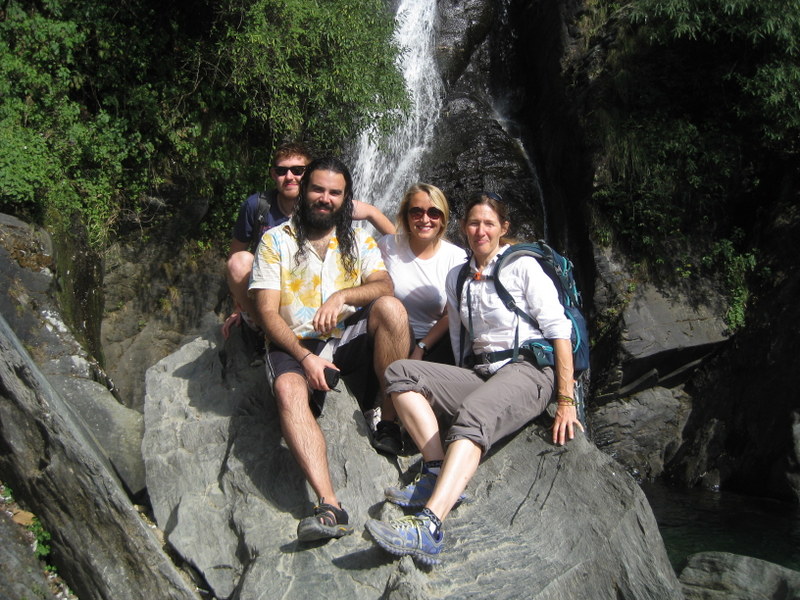
 
Friends from the overnight bus ride on a hike in the hills above McLeod Ganj (which is already about 2,000+ meters-or 6,800 feet).


Loving some Tibetan food in McLeod Ganj.


In addition, I had some really interesting interactions and conversations with the very kind Kashmiri brothers who ran the hotel I stayed in in Mcleod Ganj. I also met a Kashmiri man on one of my many walks to and from His Holiness' compound;  I had several chats with him (and a cup of tea or two) about the relationship between Kashmiris and Indians. I also enjoyed several conversations with aTibetan monk (and his nephew who translated for us) and several other refugees from Tibet. I felt such a profound connection with those who I met in the shadow (or rather in the light!) of His Holiness the Dalai Lama's compound. And of course, the teachings and presence of His Holiness was, to say the least, inspiring and transformative. And another blog post...

Long live His Holiness the Dalai Lama.

A Passage Through India, part 2

November 5, 2014
Rishikesh
Arriving the following evening in Haridwar, I grabbed a motorized pedicab to Rishikesh, the self-proclaimed "unofficial yoga capital of the world." My dad had sent me a link in the summer about Rishikesh and its relationship to yoga (I'm not sure he actually intended for me to read it and, you know, go there) and I thought it looked like a place I ought to visit--as a Beatles fan (thank you Maharishi) and as a yoga practitioner (if I may be so crass as to label myself that). Already I could tell that Haridwar was slightly less confounding then Varanasi (though I couldn't tell you how, exactly), and that Rishikesh--and in particular the High Bank side of this small(ish) city--had a different kind of energy, though also on the Ganges (but a part that ran quickly and, in some places, dangerously). The pilgrims here are comprised of a wide range of tourists, many of whom have come to seek peace, love, and yoga (much like the Beatles in the late '60s did from the Maharishi). So many yoga ashrams, so little time! I visited a few, had a fascinating Ayurvedic experience or two, and participated in just enough yoga classes during my week there to get just a little bit of the feel for yoga in Rishikesh at least.


I came to Rishikesh, I think, to experience (perhaps naively?) yoga in a more "true" form--closer to the source. I mean, Rishikesh is the "yoga capital of the world" and (though I've been teaching yoga for only a short time) it seemed like the thing to do. Again, my experience was complicated. I loved roaming around Rishikesh, taking "Laughter Yoga" (seriously, it was the best time ever), riding a bicycle in the hills, meeting folks on the side roads and pedestrian suspension bridge.  But I can also say that, in my limited experience, I found at least some of the practices steeped in what felt like a patriarchal system (not surprising based on my experience of how men treat the women). I also winced (literally) at some of the mechanics and insistence on postures being just so (heels must reach the floor in Downward Facing Dog), regardless of body type or limitations. Was I coming with my Western Orientalist limited mindset to appropriate a tradition not my own, and for my own colonizing purposes (a conversation for another day)? Or was I reacting to the ways in which this patriarchal culture seeks to keep women and others (Muslims, for example) in their place? How can I be judgmental about that which I know not? And about a place which I have over the years come to idealize, but have so little experience or knowledge? All of my reactions, responses, experiences reveal my limitations. India helped me see and work with those limitations.


Wednesday, November 12, 2014

The Magnet that is Mt. Everest


29 October 2014

We have arrived back in Kathmandu, still buzzing from the part of the ride to and from Mt. Everest Base Camp from Rongbuk Monastery on the Tibet side of Mt. Everest. Our original itinerary called for a 42-hairpin turn ride from Tingri up to Ronbuk Monastery where we would camp, the next day riding up to Base Camp, then another night camping near the Monastery, and then a ride back down toward Tingri, then on to Zhang Mu, a town in Tibet on the border of Nepal, and on the "rain" side of the Himalayas (and a much lower altitude). But our riding schedule needed to be shifted-the road to Mt. Everest was currently under construction (the roads, by and large, in Tibet were really quite good), and the alternate road was NOT in great condition, and the riding and camping conditions, both along that road and at Ronbuk Monastery, were not great, either, according to our Sherpa (in whom we trust). The camping season had ended (too cold!), and the winds were such that camping would be difficult (and we had ridden and camped in about 30 knot winds the previous night). So we piled our bikes in the truck and rode in the van to Mt. Everest. This was itself an experience!


The bridge was being repaired, so we drove through the water--our truck (with bikes and camping gear and everything else) goes first.

The Road to Everest, it turns out, isn't paved. At least this one wasn't. But the Mountain was definitely calling...

Once at Rongbuk Monastery, the highest monastery in the world, not surprisingly, we ate a quick lunch of noodles heroically prepared by our cooks in the courtyard of the Guest House run by the monastery (it was 3 pm by now). We then jumped on our bikes for the 8km ride to Base Camp. Tingri is at 14,268 ft (about 12.2% oxygen). Rongbuk Monastery is (depending on who you ask) at about 16,732 ft (5,100 meters and about 11% oxygen). We had gained over 2,000 ft in altitude from Tingri to Rongbuk Monastery, and we were about to gain an additional 600+ feet (200 meters) as we headed up to Base Camp. As a point of comparison, at sea level the air we breath contains (according to a couple of seemingly credible websites) about 20.9% oxygen. So we were dealing with a lot less oxygen. And we all could feel it. Pedaling uphill to Base Camp, it felt like each three inhales amounted to about one inhale in terms of oxygen. But there's something about Everest that is a magnet, and the lure of the mountain kept me pushing forward through those (relatively) short (but breathless!) 8 kms. 


Yukking it up with the Yaks on the road to Mt. Everest.


Advertised in our itinerary was the opportunity to take a donkey cart, or even a bus, to Base Camp if one chose not to ride. But not one of us would have done that even if we could (the carts and buses had stopped running--it was too late in the season). It just seemed like one had to bike if one could. 

won't lie, my struggle was real (as my son would say) riding up to Base Camp, but I took it slow (of course!) when I needed to in order to catch my breath, sometimes stopping. This also gave me a couple of opportunities to take photos of ever approaching Everest. Every time I stopped to look at it I was amazed. 


Mt. Everest Base Camp road selfie. No private vehicles are allowed, and a permit is also required. Thouugh no one was there to check it that day.


This happened: me at Mt. Everest.

At the very end of the ride on the way back to the Monastery Guest House (which was largely down hill, predictably), there was one uphill stretch. It was so close to the Guest House and the end of the ride, I decided (what on earth was I thinking?) to give it a little push, attack the hill (like one might at a sensible altitude). Within 10 yards I had to stop and was desperately gasping for air. I had several seconds of fully not being able to breath (it seemed a lot longer). I was telling myself, "be calm, slow inhale, you will get air." But the experience reminded me--again--of the very real challenge of functioning at very high altitude.


Yak time after the ride. We are checking each other out. I didn't want to get any closer, as you can see.

North Face and Tibetan Prayer Flags. Totally cool.

Ironically, it was one of the best biking days that we had had in days. There  was hardly any wind, and it was, strangely enough, warmer than recent riding days. 

When we got back to the Guest House, we found our way to our very modest accommodations. No running water, no bathroom, no heat. But there were walls. And, as a saving grace, the beds had electric mattress pads. I pre-heated mine while we were eating dinner. What a wonderful moment, after several nights of camping in weather so cold that my water bottle and Camelbak container froze solid (from hot water) in the tent, finally to be warm. 

In another two days we would be down to 6,562 ft from 14,268 ft in one day.